
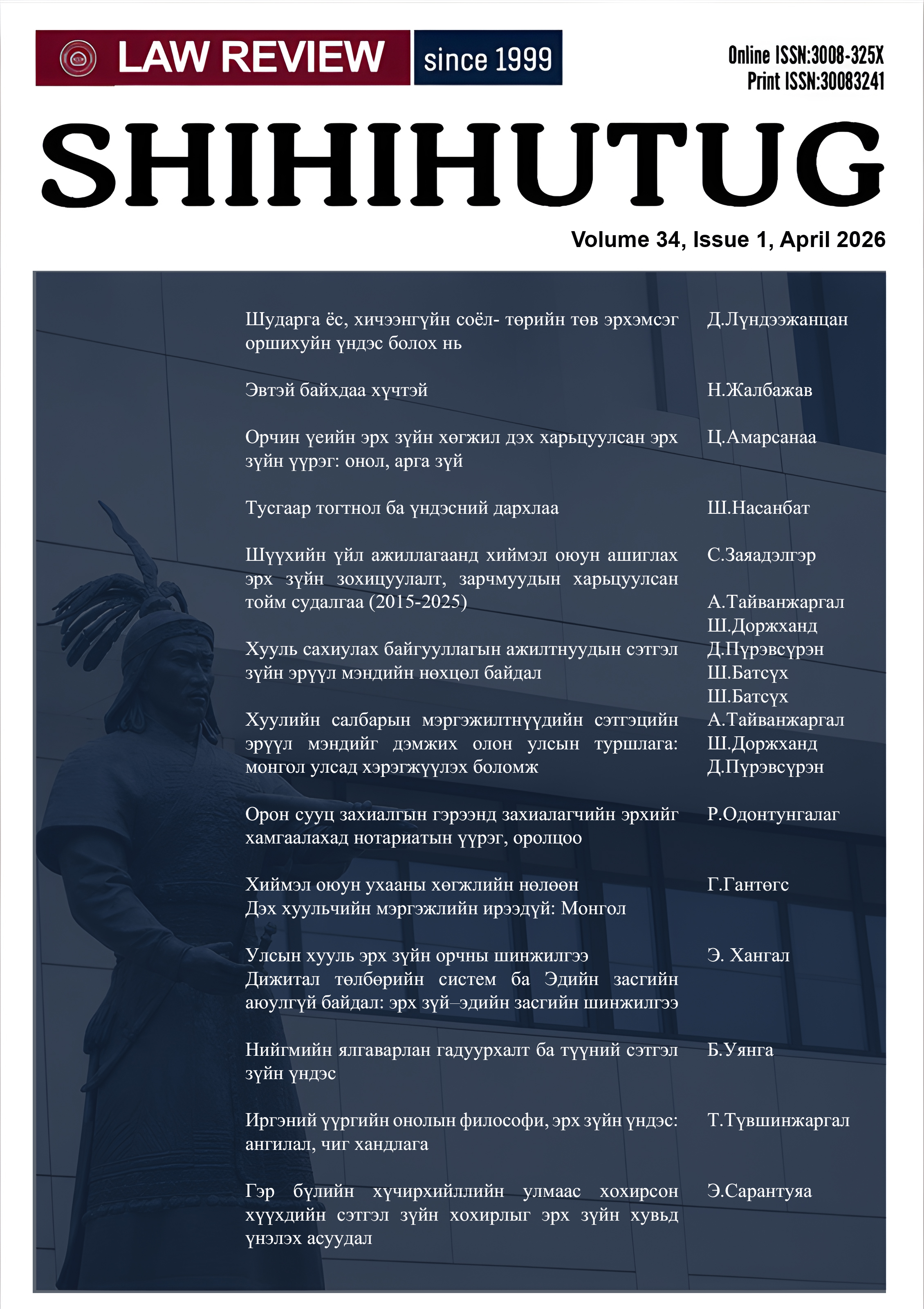
THE PHILOSOPHICAL AND LEGAL FOUNDATIONS OF CIVIC DUTIES: CLASSIFICATION AND CONTEMPORARY TRENDS
DOI:
https://doi.org/10.66582/23bzc393Keywords:
Civic Duties, Constitutional Duties, Correlation of Rights and Duties, Social Contract Theory, Civic Participation, Responsible Citizenship, Democratic GovernanceAbstract
The development of modern constitutional law has primarily focused
on guaranteeing and institutionalizing human and civil rights.
Throughout the evolution of international human rights standards and
national constitutions, the scope of rights protection has expanded
considerably, and legal mechanisms designed to protect individuals
from excessive state interference have become increasingly
sophisticated. However, this process has also contributed to the
relative neglect of the concept of civic duties and their legal and institutional status. As a result, scholars have increasingly pointed to
the emergence of an imbalance between rights and duties within
contemporary societies.
From a theoretical perspective, rights and duties are inherently
interdependent and inseparable. In practice, however, the prevailing
tendency has been to expand the scope of rights while limiting or
overlooking civic obligations. Such an approach may create an
imbalance of responsibility in the relationship between the state and
citizens, potentially undermining the foundations of constitutional
governance and social cohesion.
Civic duties should not be understood as the antithesis of rights;
rather, they constitute an essential element that conditions, supports,
and guarantees the effective realization of rights. Duties provide the
normative and institutional framework within which rights can be
exercised and protected. Consequently, the study of civic duties from
theoretical, legal, and practical perspectives is of particular
importance for ensuring social stability, the effective implementation of
the rule of law, and the sustainability of democratic governance. A
comprehensive understanding of civic duties therefore contributes not
only to constitutional theory but also to the strengthening of
responsible citizenship and the preservation of a balanced relationship
between rights and obligations in a democratic society.
Downloads
Published
Issue
Section
License
Copyright (c) 2026 SHIHIHUTUG LAW REVIEW

This work is licensed under a Creative Commons Attribution 4.0 International License.